
A Knowledge Governance Framework for RAG-Based AI and Personalized Learning in Higher Education
DOI:
https://doi.org/10.33292/ost.v6i1.199Keywords:
Artificial intelligence, Higher education, Knowledge management, Personalized learning, Retrieval-augmented generationAbstract
Background: Artificial intelligence (AI) is increasingly used in higher education, yet its educational value depends on whether outputs are grounded in reliable academic knowledge, aligned with course competencies, and reviewed by educators.
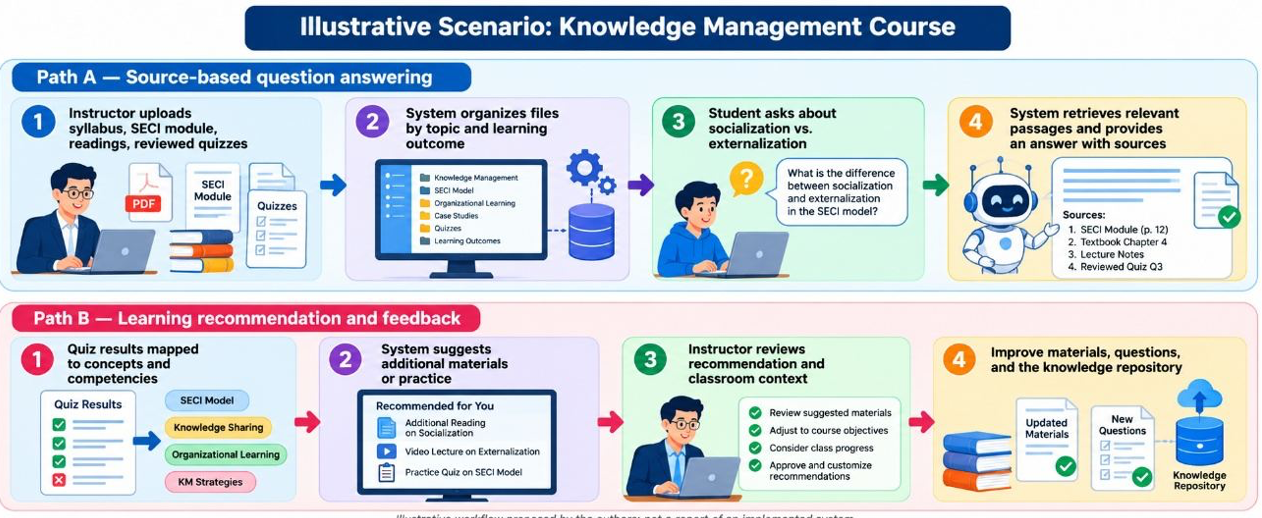
Aims: This study proposes a conceptual Knowledge Management (KM) framework integrating academic knowledge sources, a governed repository and representation layer, AI-based processing using retrieval-augmented generation (RAG), personalized learning services, and evaluation with lecturer feedback.
Methods: A focused narrative synthesis connected literature on KM, generative AI, RAG, personalization, learning analytics, and responsible AI governance. Unlike a systematic literature review, the study does not use a reproducible database-search and screening protocol and does not claim comprehensive coverage.
Result: The resulting model offers a course-level workflow, four research propositions, and indicators for future evaluation. The most important adoption priority is to establish a curated, version-controlled knowledge base linked to course learning outcomes before deploying AI-generated explanations or recommendations.
Conclusion: The framework has not been empirically validated; therefore, its effects on learning outcomes remain unknown. Future work should begin with expert validation and prototype testing of source traceability, answer accuracy, recommendation relevance, privacy safeguards, and lecturer oversight.
References
Baig, M. I., & Yadegaridehkordi, E. (2024). ChatGPT in higher education: A systematic literature review and research challenges. International Journal of Educational Research, 127, Article 102411. https://doi.org/10.1016/j.ijer.2024.102411
Banihashem, S. K., Noroozi, O., van Ginkel, S., Macfadyen, L. P., & Biemans, H. J. A. (2022). A systematic review of the role of learning analytics in enhancing feedback practices in higher education. Educational Research Review, 37, Article 100489. https://doi.org/10.1016/j.edurev.2022.100489
Bond, M., Khosravi, H., De Laat, M., Bergdahl, N., Negrea, V., Oxley, E., Pham, P., Chong, S. W., & Siemens, G. (2024). A meta systematic review of artificial intelligence in higher education: A call for increased ethics, collaboration, and rigour. International Journal of Educational Technology in Higher Education, 21, Article 4. https://doi.org/10.1186/s41239-023-00436-z
Drugova, E., Zhuravleva, I., Zakharova, U., & Latipov, A. (2024). Learning analytics driven improvements in learning design in higher education: A systematic literature review. Journal of Computer Assisted Learning, 40(2), 510–524. https://doi.org/10.1111/jcal.12894
Farhood, H., Nyden, M., Beheshti, A., & Muller, S. (2025). Artificial intelligence-based personalised learning in education: A systematic literature review. Discover Artificial Intelligence, 5, Article 331. https://doi.org/10.1007/s44163-025-00598-x
González-Pérez, L. I., García-Peñalvo, F. J., & Argüelles-Cruz, A. J. (2025). Data-driven learning analytics and artificial intelligence in higher education: A systematic review. IEEE Revista Iberoamericana de Tecnologías del Aprendizaje, 20, 440–451. https://doi.org/10.1109/RITA.2025.3615512
Hagos, H. G., Lesjak, D., Flogie, A., & Babu, R. (2025). Artificial intelligence in knowledge management for higher education: Transformative impact, challenges, and future directions post-COVID-19. Journal of Information Systems Engineering and Management, 10(3s), 344–359. https://doi.org/10.52783/jisem.v10i3s.414
Hattie, J., & Timperley, H. (2007). The power of feedback. Review of Educational Research, 77(1), 81–112. https://doi.org/10.3102/003465430298487
Kasneci, E., Sessler, K., Küchemann, S., Bannert, M., Dementieva, D., Fischer, F., Gasser, U., Groh, G., Günnemann, S., Hüllermeier, E., Krusche, S., Kutyniok, G., Michaeli, T., Nerdel, C., Pfeffer, J., Poquet, O., Sailer, M., Schmidt, A., Seidel, T., . . . Kasneci, G. (2023). ChatGPT for good? On opportunities and challenges of large language models for education. Learning and Individual Differences, 103, Article 102274. https://doi.org/10.1016/j.lindif.2023.102274
Lewis, P., Perez, E., Piktus, A., Petroni, F., Karpukhin, V., Goyal, N., Küttler, H., Lewis, M., Yih, W.-T., Rocktäschel, T., Riedel, S., & Kiela, D. (2020). Retrieval-augmented generation for knowledge-intensive NLP tasks. Advances in Neural Information Processing Systems, 33, 9459–9474. https://doi.org/10.48550/arXiv.2005.11401
Miao, F., & Holmes, W. (2023). Guidance for generative AI in education and research. UNESCO. https://doi.org/10.54675/EWZM9535
Misiejuk, K., López-Pernas, S., Kaliisa, R., & Saqr, M. (2025). Mapping the landscape of generative artificial intelligence in learning analytics: A systematic literature review. Journal of Learning Analytics, 12(1), 12–31. https://doi.org/10.18608/jla.2025.8591
Nonaka, I., & Takeuchi, H. (1995). The knowledge-creating company: How Japanese companies create the dynamics of innovation. Oxford University Press. https://doi.org/10.1093/oso/9780195092691.001.0001
Ouyang, F., & Zhang, L. (2024). AI-driven learning analytics applications and tools in computer-supported collaborative learning: A systematic review. Educational Research Review, 44, Article 100616. https://doi.org/10.1016/j.edurev.2024.100616
Rodríguez-Ortiz, M. Á., Santana-Mancilla, P. C., & Anido-Rifón, L. E. (2025). Machine learning and generative AI in learning analytics for higher education: A systematic review of models, trends, and challenges. Applied Sciences, 15(15), Article 8679. https://doi.org/10.3390/app15158679
Safrizal, S., Widjaja, Y., & Jaya, S. (2026). Manajemen pengetahuan: Teori, model, teknologi, dan penerapannya. CV. Science Tech Group. https://www.neliti.com/publications/740464/manajemen-pengetahuan-teori-model-teknologi-dan-penerapannya
Safrizal, Anwar, C., El Rayeb, A., Simamora, Y. C., Hasugian, A. V., & Alfian, J. A. (2026). Student certification recommendation model based on personalized learning using classification and regression tree (CART). In 2026 International Conference on Smart Computing, Internet of Things, and Machine Learning (SIML) (pp. 1–5). IEEE. https://doi.org/10.1109/SIML69834.2026.11621060
Shute, V. J. (2008). Focus on formative feedback. Review of Educational Research, 78(1), 153–189. https://doi.org/10.3102/0034654307313795
Wang, S., Wang, F., Zhu, Z., Wang, J., Tran, T., & Du, Z. (2024). Artificial intelligence in education: A systematic literature review. Expert Systems with Applications, 252, Article 124167. https://doi.org/10.1016/j.eswa.2024.124167
Yusuf, A., Pervin, N., Román-González, M., & Noor, N. M. (2024). Generative AI in education and research: A systematic mapping review. Review of Education, 12(2), Article e3489. https://doi.org/10.1002/rev3.3489
Zawacki-Richter, O., Marín, V. I., Bond, M., & Gouverneur, F. (2019). Systematic review of research on artificial intelligence applications in higher education—Where are the educators? International Journal of Educational Technology in Higher Education, 16, Article 39. https://doi.org/10.1186/s41239-019-0171-0
Zhang, X., Zhang, P., Shen, Y., Liu, M., Wang, Q., Gaševi?, D., & Fan, Y. (2024). A systematic literature review of empirical research on applying generative artificial intelligence in education. Frontiers of Digital Education, 1(3), 223–245. https://doi.org/10.1007/s44366-024-0028-5
Downloads
Published
How to Cite
Issue
Section
License
Copyright (c) 2026 Safrizal Safrizal, Lukman Medriavin Silalahi, Hayadi Hamuda

This work is licensed under a Creative Commons Attribution-ShareAlike 4.0 International License.


